Conda Dependency Firewall
Conda environments can pull prebuilt packages from multiple channels. Bytesafe applies one policy layer across them and blocks risky packages before they reach your environment.
Dependency Firewall sits in front of your existing repository, protecting developers, CI/CD pipelines and AI agents.
EU-based company · Software supply chain security since 2018.
Logs
| Time | Status | Package | Version | Rule |
|---|---|---|---|---|
| 09:58:15 | Allowed | scikit-learn | 1.7.2 | Log all downloads |
| 09:58:12 | Allowed | openssl | 3.5.4 | Exception |
| 09:58:09 | Blocked | pytorch | 2.9.0 | Delay 7 days |
| 09:58:06 | Allowed | pandas | 2.3.2 | Log all downloads |
| 09:58:03 | Blocked | pillow | 9.0.0 | Block CVSS ≥ 7 |
| 09:58:00 | Allowed | numpy | 2.3.3 | Log all downloads |
| 09:57:57 | Allowed | scipy | 1.16.2 | Log all downloads |
| 09:57:54 | Allowed | matplotlib | 3.10.6 | Log all downloads |
Intercepts every Conda package request before it reaches you.
Every package install is a potential entry point. Traditional SCA tools find problems after packages are already in your environment. Dependency Firewall intercepts every Conda request before it reaches your developers, CI/CD pipelines or AI agents.
You define the rules: block packages with known CVEs, block known malicious packages, or delay newly published versions for a configurable period to give the ecosystem community time to surface zero-day threats.
Works in front of enterprise repository platforms and any Conda registry. No agent installs. No workflow changes.
Public Conda registry
Vulnerable and malicious versions included

Dependency Firewall
Policy engineDevelopers and CI/CD
Internal environment
What Dependency Firewall does for Conda
Each firewall runs the checks you turn on, on every package request. Rules block or log, and every decision is recorded.
- Malware blocking
- Blocks packages that match malware data, including malicious payloads and suspicious install hooks. Every block is logged with the package and the rule.
- Package delay
- Holds newly published versions for a window you set, so malware feeds can catch a bad release before your builds install it.
- Exception workflow
- Developers request an exception from the blocked install. The team you choose approves it, adjusting scope or expiry, or denies it with a comment. Every request and decision is in the audit log.
- Dependency confusion
- Upstream priority rules make internal package names always resolve from your private registry. A public package with the same name cannot take its place.
- Package observations
- Every package that passes records first-seen and last-seen time and request counts. When a new advisory lands, you see which firewalls served the package and since when.
- Audit log
- Every allow, block and exception is logged with the package, version, rule, requester and time. Export it to your SIEM.
- A firewall per team
- Run a separate firewall per team, pipeline or registry. A shared baseline firewall runs first, and team firewalls add rules on top without weakening it.
- Licenses
- Blocks packages with licenses you have not approved before they reach a build.
- Rules as code
- Every firewall is a small JSON configuration. Keep it in Git, deploy it through your automation over the API and roll back to any earlier version.
Half the base fee for your first 3 months
€49.50 instead of €99 per month, plus €100 usage credit. Start with a 14-day trial. See what's new
Current limitations
No vulnerability blocking yet
CVE and EPSS based rules aren't available for Conda. The dashboard doesn't offer them for Conda firewalls, and the API rejects a vulnerabilities rule.
License rules see unknown only
There's no license data source for Conda packages yet, so every version resolves as unknown license. Only the unknown option in a license rule has any effect.
Read-only channel
The firewall serves Conda channels read-only. There's no publish-scanning phase for uploads yet.
How Conda installs go through the firewall
Your package manager asks the firewall instead of the public registry. The firewall fetches the package from upstream, checks it against your rules and serves it only if it passes.
- 1
Change the registry setting
Point conda, mamba or micromamba at the firewall, on laptops and CI runners. Lockfiles, manifests and install commands stay the same.
Developer or CI job
conda install numpy
Dependency Firewall
Checks your rules
Public registry
conda.anaconda.org
- 2
Set the rules
Block by CVSS or EPSS score, known malware, license or package age. Shared rules go on a baseline firewall that team and CI firewalls inherit, and they run first.
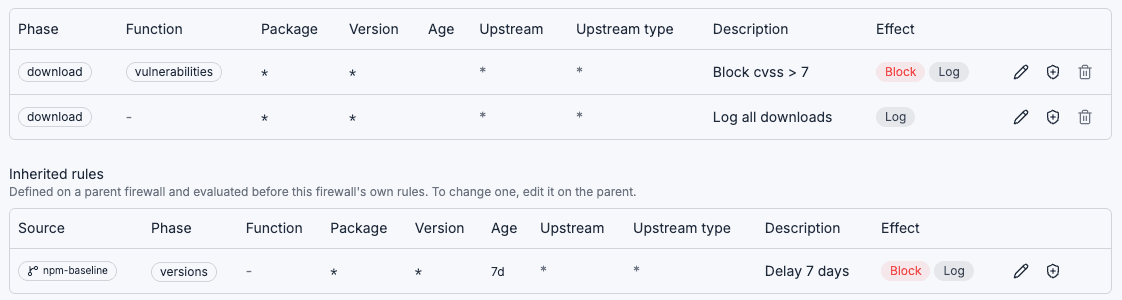
Rules on the npm-ci firewall. The 7-day delay is inherited from npm-baseline. Shown for npm. - 3
Read the log
A version held back by a rule is left out of the version list, so the package manager resolves an older one. A blocked download fails the install. Every decision is logged with the rule and who asked.
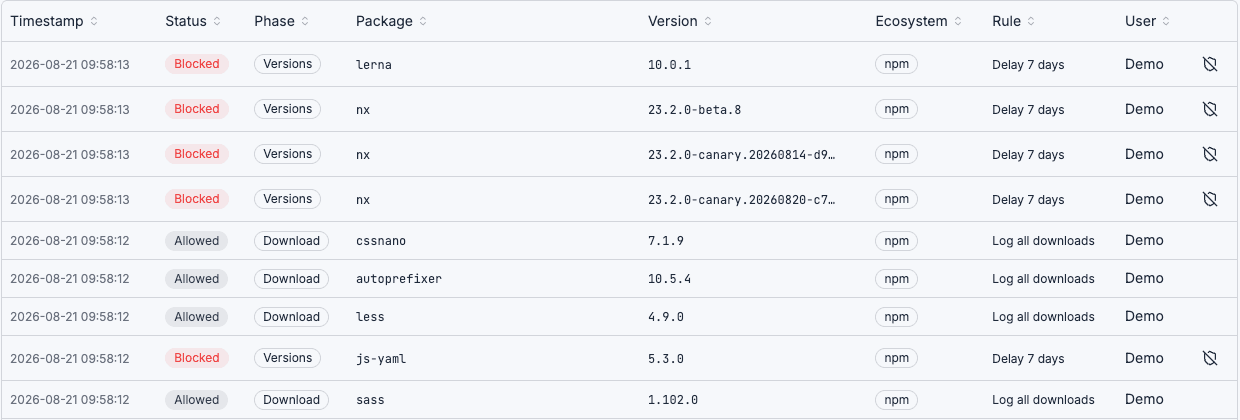
New versions held by the delay rule, next to allowed downloads. Shown for npm.
Point conda, mamba or micromamba at Bytesafe Dependency Firewall
Set the firewall as the only channel with --override-channels, so no other configured channel or cached conda-forge entry can resolve packages around it. Credentials ride in the channel URL: HTTP basic auth with username __token__ and your Bytesafe access token as the password.
Works with the repositories you already use
Inside Dependency Firewall
The screens your developers and security team work with.
1 of 7 · Logs
Live firewall logs
Every request is logged: package name, version, status, ecosystem, which firewall evaluated it, which rule triggered and who requested it. Filter by firewall or user, and tail live during incidents or CI/CD runs.
Developers get a fast answer when an install fails, and AppSec gets an audit trail for every decision.
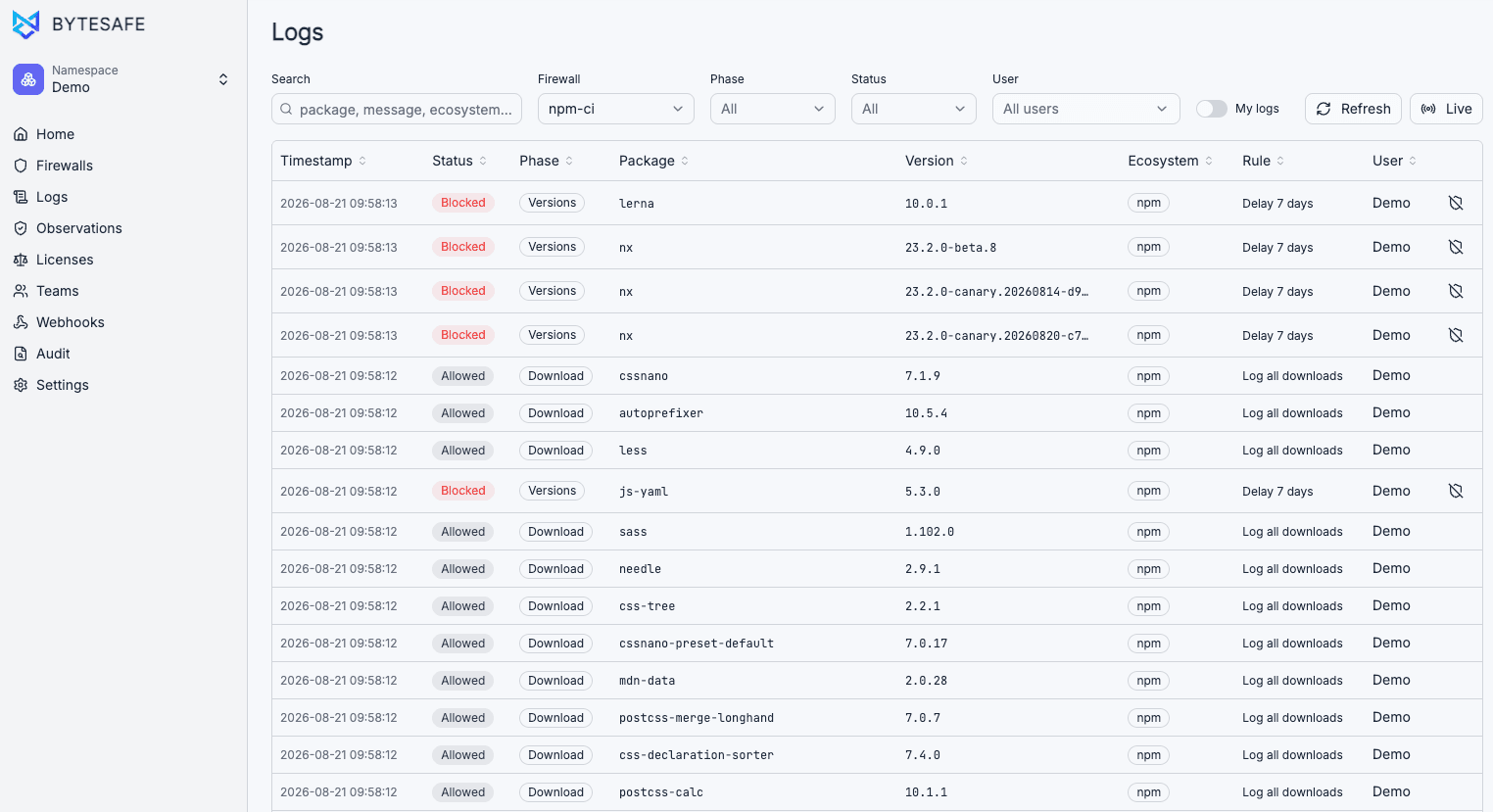
Why a package was blocked
Open a blocked request to see the package, how old the release is, the rule that stopped it and when it will be allowed.
Add or request a time-limited exception from the same drawer to let one package or version through while the rule keeps applying to everything else. The decision stays attached to the original request, so nothing has to be reconstructed from CI output later.
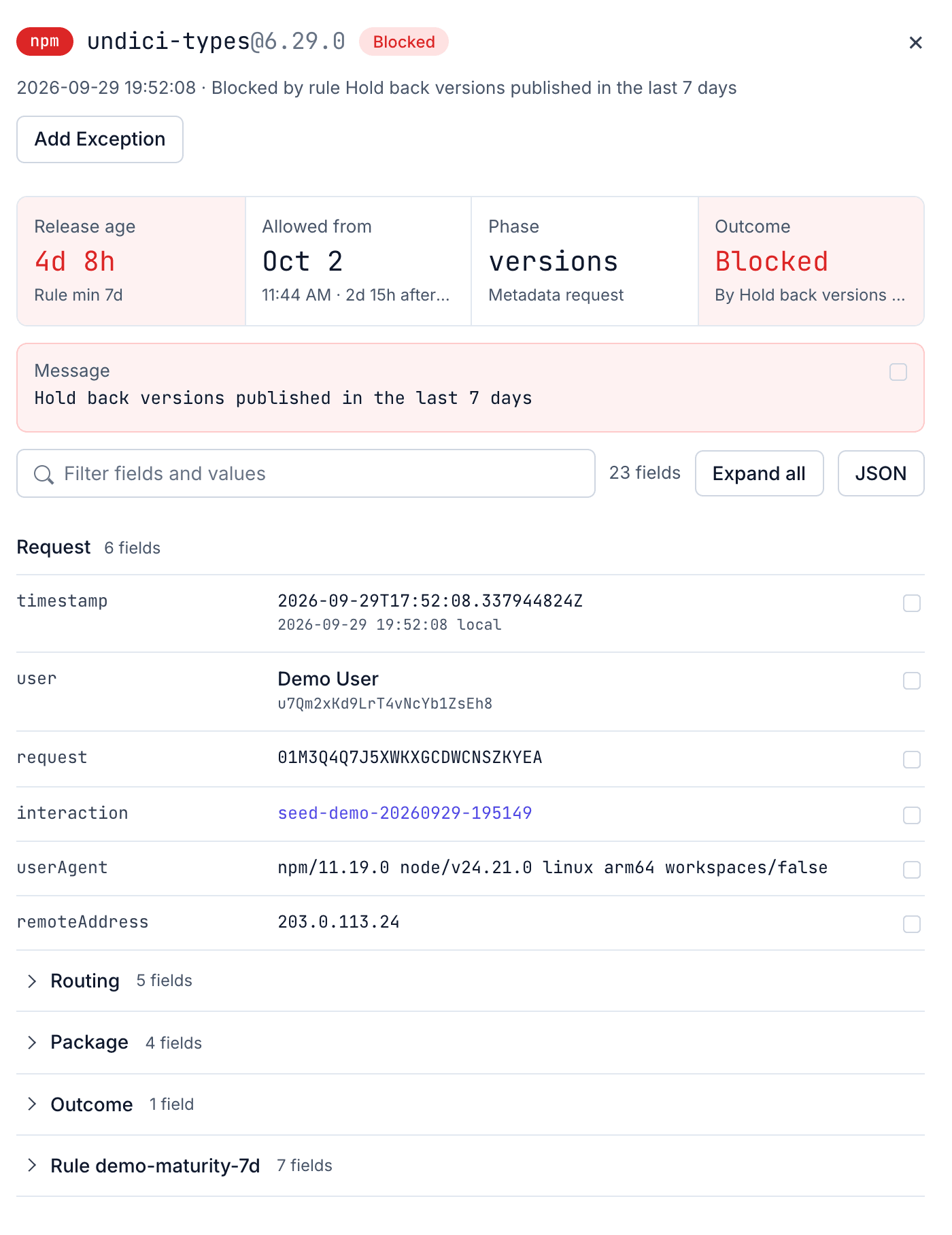
Firewall rules
Each rule targets an ecosystem and applies a condition: vulnerability severity, package age, license or name pattern. Rules block or log, stack per firewall and take effect immediately.
Start with broad guardrails, then narrow by upstream, package, version range, internal status, maximum age, CVSS score and EPSS score.
See everything a rule can match on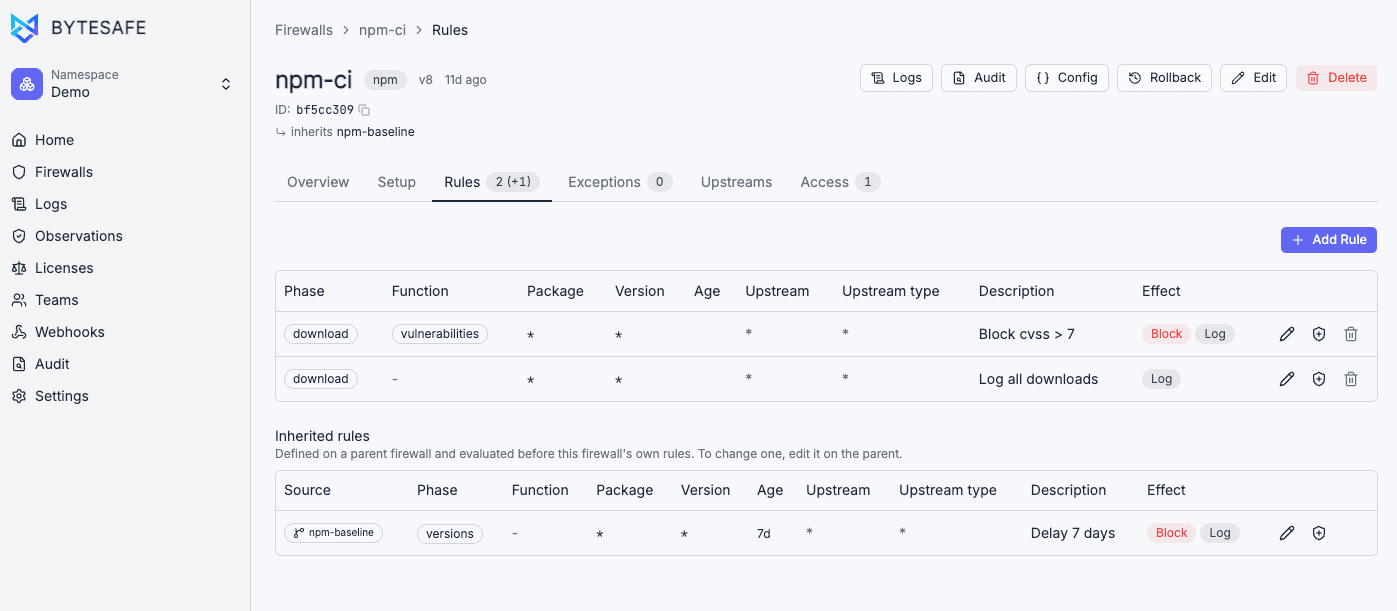
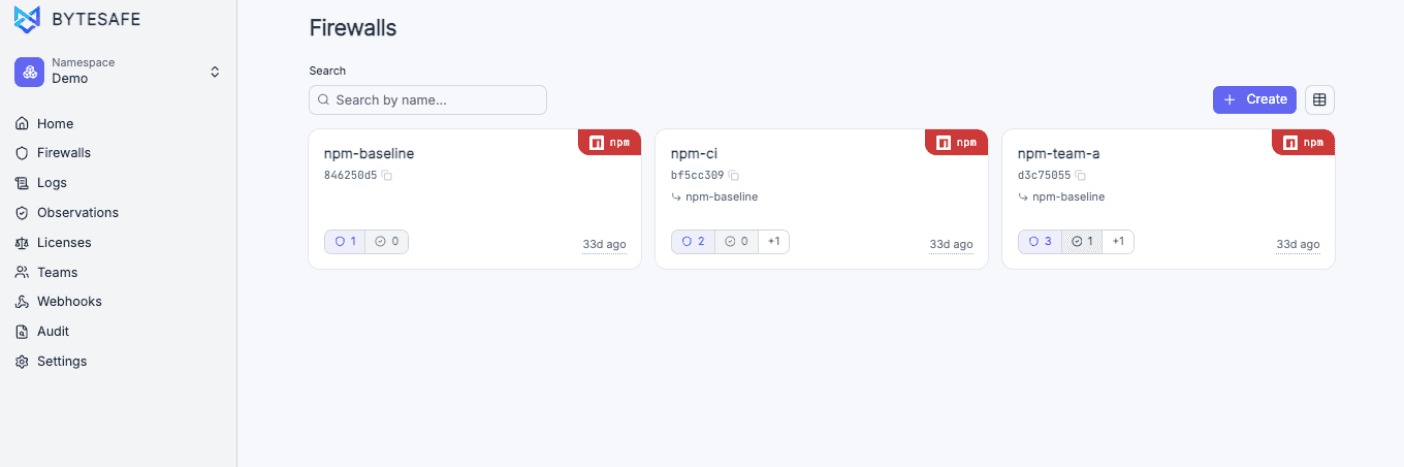
A firewall per team or pipeline
Each firewall carries its own rules, exceptions and upstreams, so a CI firewall can be stricter than a local dev one.
A firewall can inherit from another. Set one baseline with the rules every project must follow and point team firewalls at it. Inherited rules run first and can only be changed on the parent.
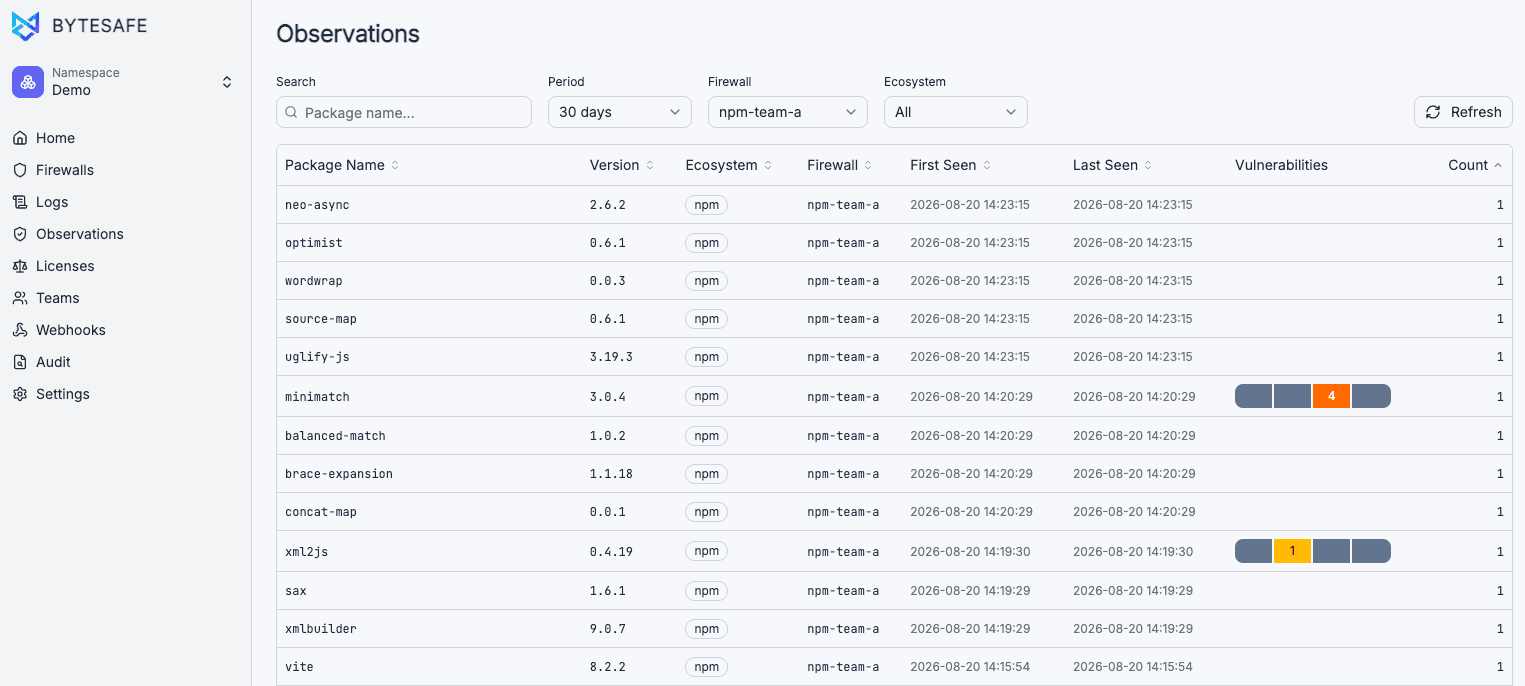
Every package that passed through
See which packages each firewall served over a period, with ecosystem, version, first-seen and last-seen time, vulnerability signals and request counts.
When a new advisory or malware report appears, search for the package and see where it was observed and when exposure started.
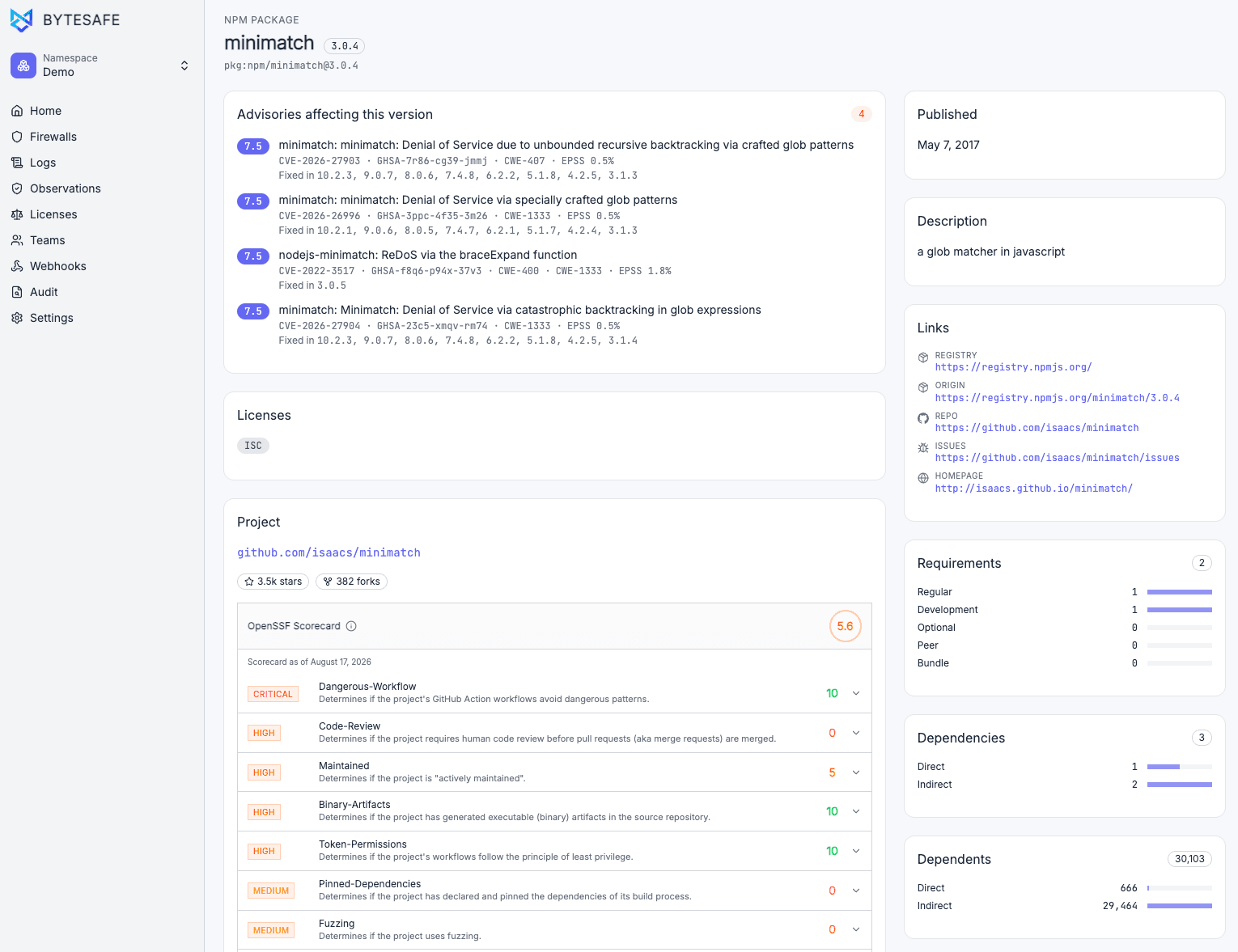
Package details and scorecards
Review advisories, licenses, project metadata, OpenSSF Scorecard checks, dependency counts and source links before you block, allow or investigate further.
Security dashboard
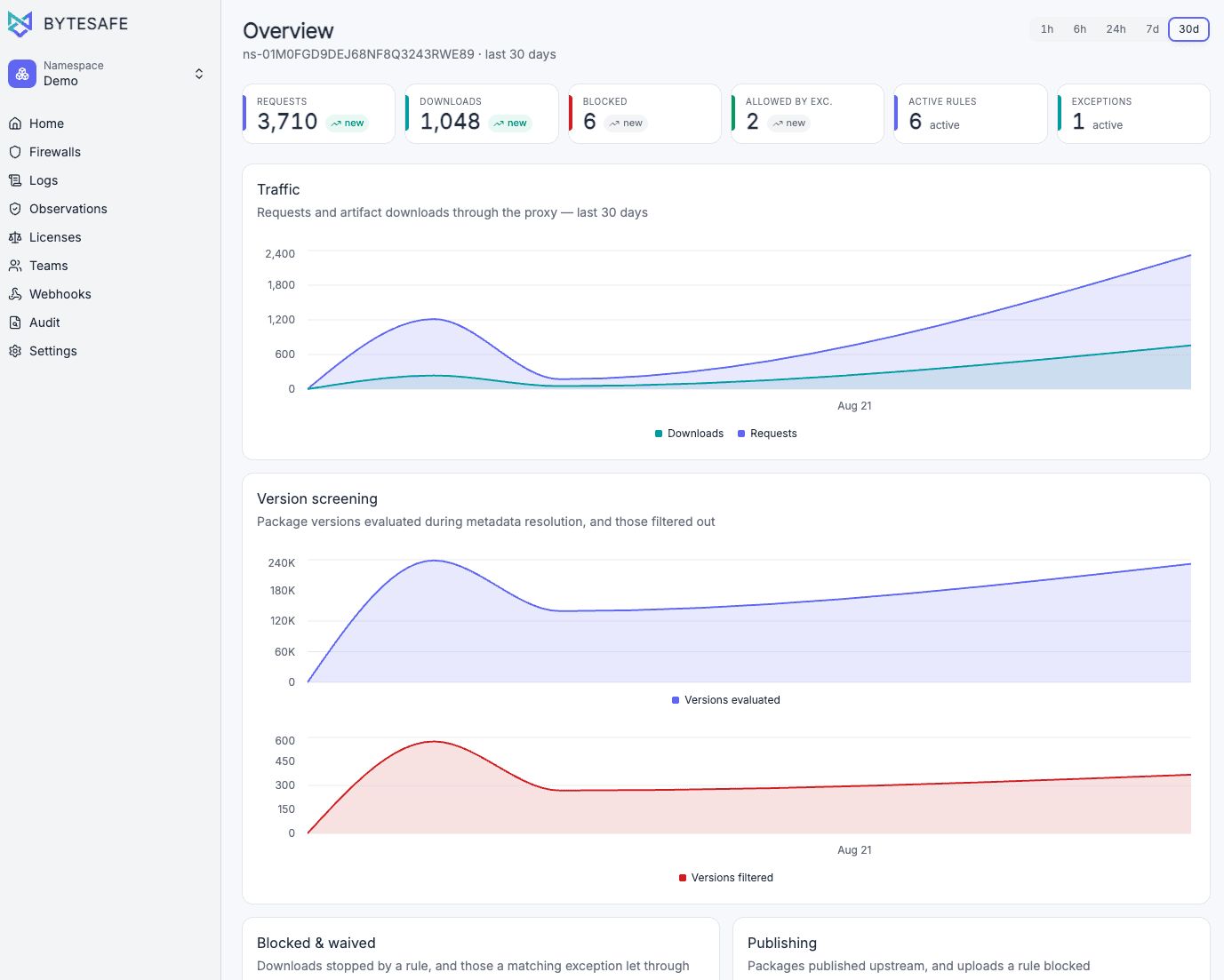
Rules triggered, exceptions granted and package requests over time. See which firewalls are most active and confirm your policies work after rollout.
Known attacks on Conda
Malicious releases, account takeovers and dependency confusion have all been used against packages there.
conda-forge token exposure
Infrastructure exposure
- Misconfigured build infrastructure leaked the anaconda.org upload token for the conda-forge channel to every feedstock maintainer for about seven weeks (CVE-2025-31484). Anyone holding it could have uploaded or overwritten packages in the production channel. An audit found no packages were altered before the token was revoked.
conda-forge-metadata
Unclaimed dependency
- The conda-forge-metadata package declared an optional dependency, conda-oci-mirror, that had never been published under that name. Anyone could have claimed it and shipped code that ran on install, a flaw rated 9.3 CVSS before it was fixed.
xz backdoor check
Build toolchain backdoor
- When the CVE-2024-3094 backdoor in xz surfaced, conda-forge had to confirm its own builds were clean. Its last xz upload predated the compromised 5.6.x release line, so conda-forge artifacts were unaffected, but every team running a conda-distributed xz needed to run the same check.
Also blocks vulnerable and malicious container images before they reach a build agent or production node.
Container Dependency FirewallCompared with other enterprise dependency firewalls
Other enterprise dependency firewalls are often bundled into repository platforms. Dependency Firewall is an independent firewall that works with any registry and is built in the EU.
| Criterion | Dependency Firewall | Other enterprise firewalls |
|---|---|---|
| Works with your existing repository | Yes, as a proxy in front of it | Bundled into their platform most often |
| Deploys in minutes | Yes | Usually weeks of platform work most often |
| Predictable pricing | One meter sets the price, no overage | Several axes with overage most often |
| EU data residency | Yes | No, US-based most often |
Frequently asked questions
How do I point conda or mamba at Bytesafe Dependency Firewall?
Does it work with mamba and micromamba?
What's different about Conda support today?
Can I delay new Conda package versions the same way as npm or PyPI?
Can different Conda projects have different policies?
Can Conda packages be delayed before they reach developers?
What happens if a Conda package passes through but malware is found later?
Can firewall rules be automated?
Does Dependency Firewall work with enterprise repository platforms?
How is licensing structured?
Put Conda installs behind the firewall
Try the setup above on one project and check the firewall log after the next install. Or book a demo and go through your registries and rules with an engineer.